Navigation Types
Navigation Types show how users access a web page. They might, for example, type the URL directly, reload the page, or return via the browser history.
Understanding the different navigation types is important because some are far faster than others. From a speed optimization perspective, the goal is to convert as many users as possible to fast navigation types.
In browsers they are exposed via APIs such as PerformanceNavigationTiming.type . Google collects them from users in the CrUX data set. For your site you can obtain them within the PageSpeed.cz PLUS monitoring.
There are several reasons to track Navigation Types:
- They help understand user behavior and optimize pages for faster loading, improving the user experience and SEO, as well as other business aspects.
- They allow identifying loading problems and analyzing how different navigation methods impact site performance.
- They assist in planning and implementing caching and prerendering strategies, leading to better performance of web apps.
| Navigation Type | Description |
|---|---|
navigate | Direct page load by the user typing the URL or clicking a link. |
navigate_cache | HTML loaded from the browser cache. |
reload | User reloads the page. |
restore | Page reloaded after a browser restart or tab restart due to memory. |
back_forward | Back or forward in browser history. |
back_forward_cache | Loading from BFCache, used for instant display from history. |
prerender | Prerendering for faster display on future requests, e.g. via Speculation Rules API. |
What can you do with it?
Knowing Navigation Types lets you optimize rendering for fast navigations:
- Implement BFCache: enables quick loading when users navigate through history.
- HTML caching: efficient storage and reuse for repeated loads; improves CDN caching as well.
- Prerendering: prerender key pages, e.g. with the Speculation Rules API.
PageSpeed.cz PLUS monitoring uses Navigation Types data to better understand user interactions and optimize sites for faster loading.
In monitoring we can track over time how different navigation types affect speed and UX, letting you tailor your strategies to improve the site.
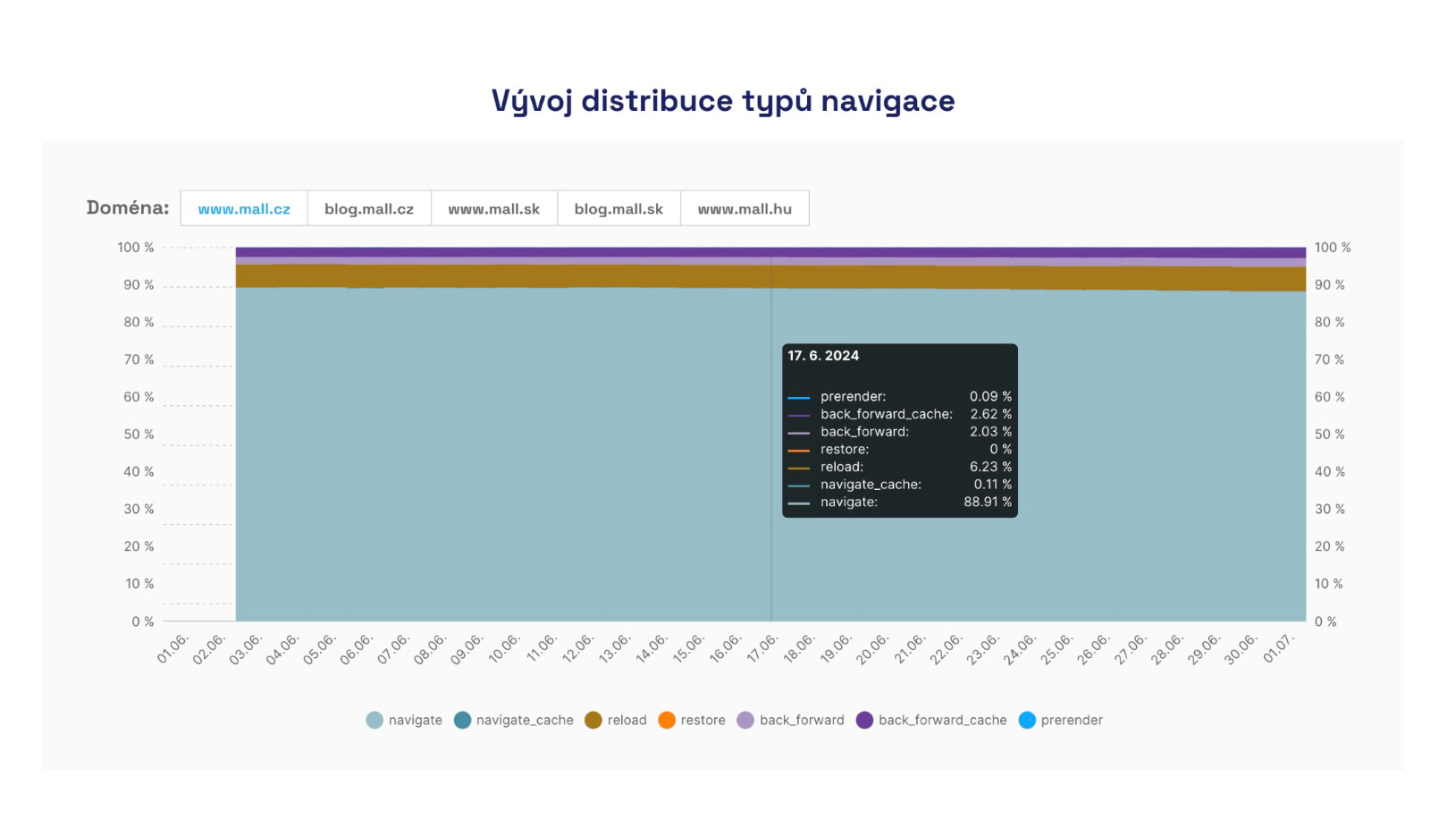 Distribution of navigation types on Mall.cz.
As you can see, fast navigation types on many sites appear only in a few percent of page views. Navigation Types can thus be a significant and readily actionable optimization opportunity.