Lighthouse Performance Score (LPS)
Lighthouse Performance Score (LPS) is a synthetic metric used to evaluate the speed and performance of websites, provided by the Lighthouse tool. The score is calculated from a range of metrics that simulate a user loading the page and provides an evaluative view of content speed and accessibility.
Included Metrics and Their Weights
Lighthouse computes the overall LPS based on several key metrics, each assigned a weight reflecting its significance to the user experience.
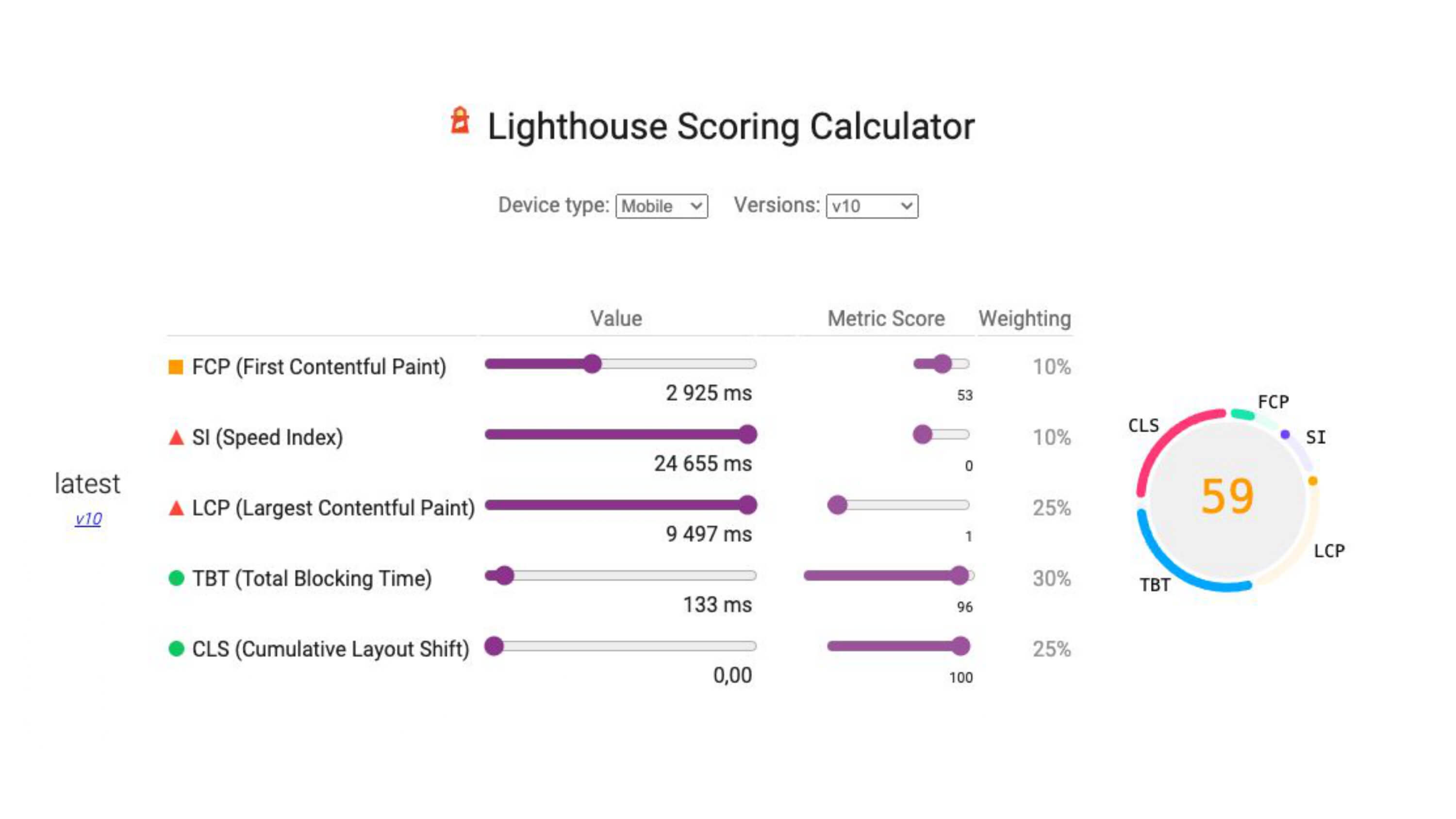
- First Contentful Paint (FCP) (weight 10%): Measures the time from navigation to the moment the browser renders the first bit of content. FCP is key to perceived page speed.
- Speed Index (SI) (weight 10%): Reflects how quickly the content is visually painted. Lower values mean faster loading.
- Largest Contentful Paint (LCP) (weight 25%): Measures the time when the largest content element on the page is rendered. LCP is crucial for assessing when the main content becomes available.
- Total Blocking Time (TBT) (weight 30%): Measures the total time the browser's main thread is blocked. TBT is essential for evaluating how responsive the page feels to user interactions.
- Cumulative Layout Shift (CLS) (weight 25%): Assesses how often users experience unexpected layout shifts. CLS matters for evaluating stability during loading.
How to Measure?
Measuring the Lighthouse Performance Score can be done directly in Chrome DevTools, using PageSpeed Insights, or by integrating Lighthouse CI into development workflows. Each tool provides a detailed report, including metric scores and improvement recommendations.
Why the Lighthouse score doesn’t tell you everything about site speed?
A common misconception is using the Lighthouse score as a proxy for overall site speed or the speed of a specific page.
The Lighthouse score doesn’t reflect actual speed. Why?
- It’s a synthetic measurement generated by a tool, not from real users.
- You’re measuring only a single page. For a domain input, it’s effectively the homepage.
- Core Web Vitals metrics aren’t fully captured by Lighthouse. CLS is only partially accounted for, and interaction delays measured by INP aren’t included.
- In tools like PageSpeed Insights, the Lighthouse score is configured quite strictly, especially in Central European contexts.
See the graphic for a practical example: three sites with very different Lighthouse scores:
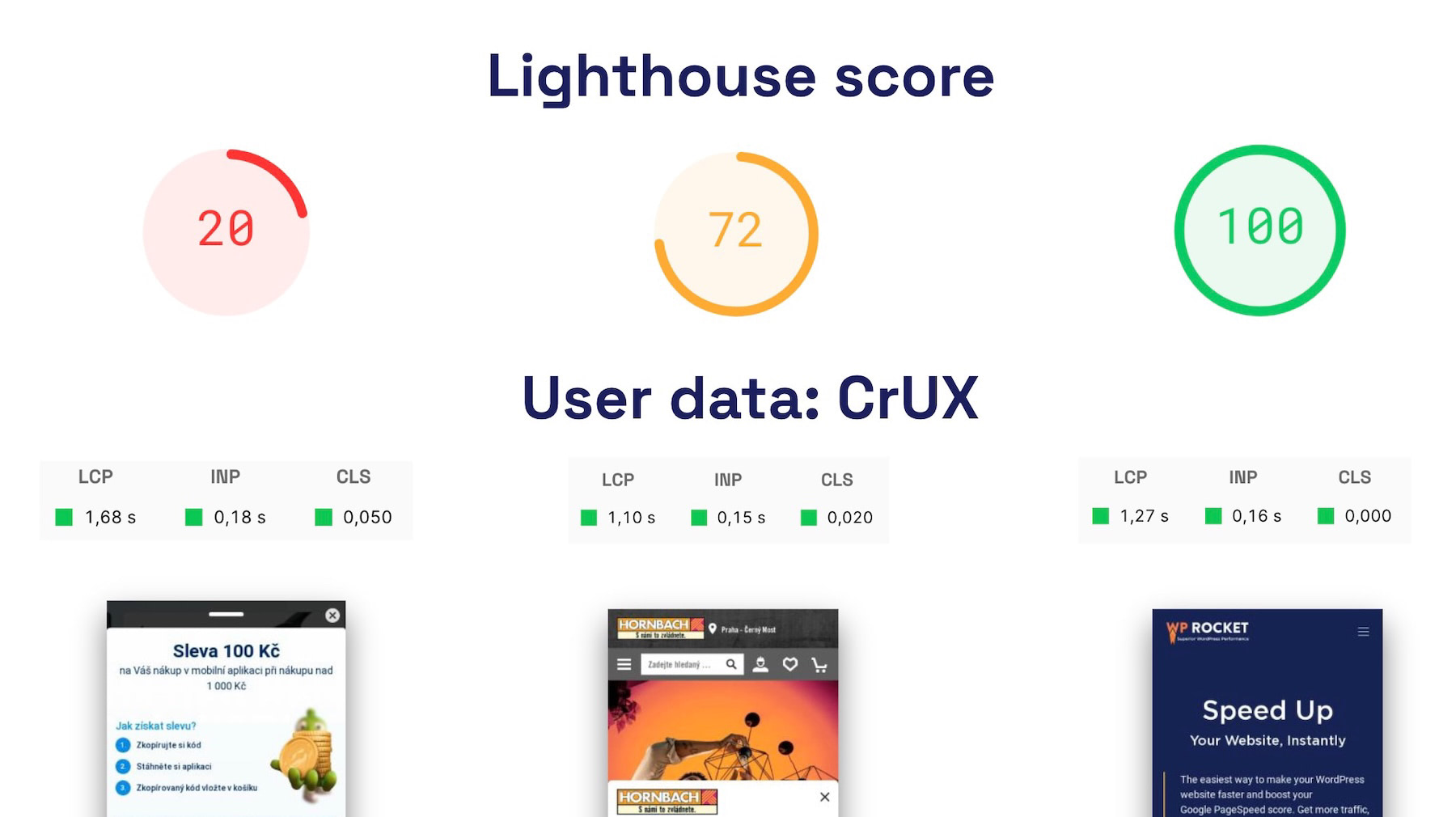 All three sites have valid speed data from users (CrUX), and as shown, Lighthouse scores can vary widely.
Don’t use the Lighthouse score to measure your site’s speed.
The Lighthouse Score (LPS) is a metric designed for speed-lowering workflows. It can be valuable for developers or testers, especially when optimizing performance or automatically ensuring that a new state doesn’t regress.
In PageSpeed.cz monitoring we use a unifying metric over Core Web Vitals, the PageSpeed.cz Score. If you’re looking for a single number to express site speed, check it out.
The Value of Synthetic Measurement
LPS is a synthetic super-metric because it combines five different metrics.
Regular daily measurements of the Lighthouse score show the speed status of a portion of your site's performance. The advantage of synthetic measurement is cost-effectiveness and relatively detailed insight.
Together with historical data, synthetic metrics can be easily compared and tracked over time. LPS and other synthetic metrics can quickly reveal issues arising during development.
In PageSpeed.cz Monitoring Plus, we also use synthetic measurements. The Watchdog Report runs Lighthouse daily and sends alerts when metrics exceed configured thresholds.
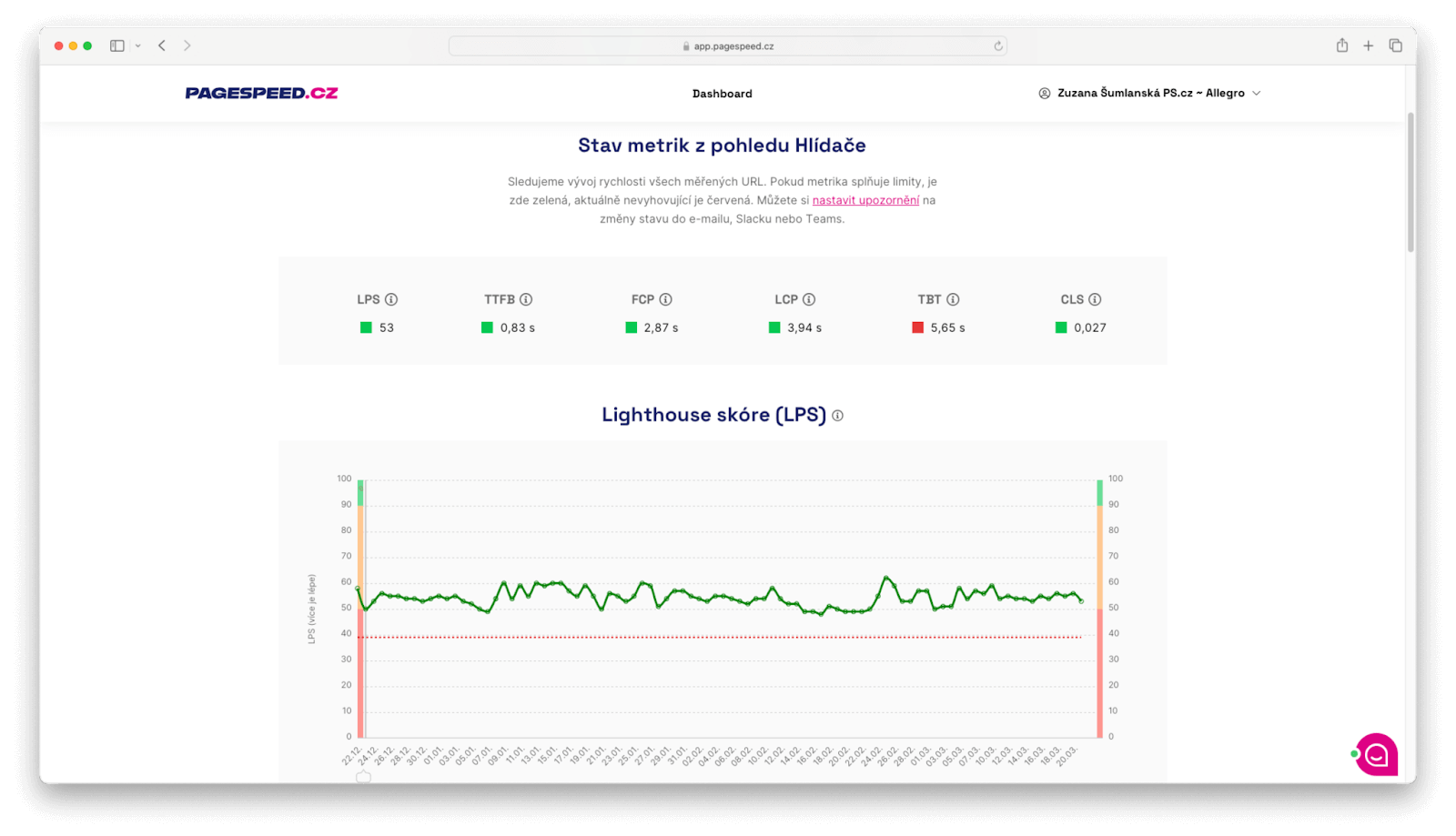
Synthetic measurements, of course, won’t tell you how fast your site is for real users on their devices. For that, you also need real-user measurements (RUM) or CrUX data from Google users, which we also provide.
We discuss the differences between measurements on a dedicated page: Synth vs. CrUX vs. RUM.
Tagy:MetrikySyntetická měřeníLighthouse
PředchozíLargest Contentful Paint (LCP)DalšíSkóre PageSpeed.cz (SPS)