PageSpeed.cz Study: The Impact of Chat Widgets on Website Speed
Live chat is used by 20% of Czech e-commerce operators. But how do these widgets affect site speed? We dug into the ten most popular live chats and uncovered a number of interesting findings.
A summary of our findings may be familiar from our livestream “Speed Matters.” We present the full study in detail in the text below.
From a speed perspective, LimeTalk, Daktela, and LiveAgent performed the best. But speed-wise you won’t necessarily go wrong with the most popular SmartSupp.
Be cautious with Manychat, Zopim, and the well-known Facebook Chat Plugin (Messenger). The speed impact varies greatly between chats. By the way, one of them can drop your Lighthouse score by a full 35 points out of 100.
What are the most popular live chat services in the Czech Republic?
A Reshoper study from this year found that roughly one in five Czech e-shops use a chat widget. Live chats therefore have a meaningful impact on user experience for online shoppers.
Thanks to Filip Podstavec from Marketing Miner, we obtained updated data in November 2020 on the most-used website chats in the Czech Republic. Smartsupp clearly leads, but the top ten is as follows:
- Smartsupp
- Facebook Chat Plugin
- Tawk
- Zendesk/Zopim
- FoxyDesk
- Livechatoo
- LimeTalk
- Daktela
- LiveAgent
- Manychat
How we measured
Our methodology looked like this:
- We embedded each live chat on a completely blank page following the manufacturer's instructions, and also on a more complex page built with the Landkit template.
- Each test page was measured for several days with synthetic tests from SpeedCurve, simulating a slow mobile device (Samsung Galaxy S4). The resulting dashboard is available, as are the test results in a Google Sheet.
- Our colleague Michal Matuška additionally performed manual browser tests on the most popular services to validate synthetic results and explore potential improvements for both site owners and widget authors.
What did we measure?
To compare results, we used several available speed metrics.
Let’s start with the technical indicators. In the overall picture, these are less central, but you’ll see why we examined them.
Data transferred
The data volume downloaded by widgets may seem minor today. However, as a site operator you wouldn’t want users to download an extra megabyte solely for chat. If you think this can’t happen, keep reading.
Results:
- LimeTalk stood out with only 8 KB transferred.
- Facebook Messenger pulls in over 1 MB of data. ManyChat reaches about 1.1 MB.
Number of files downloaded
In the era of HTTP/2 and HTTP/3, the number of files isn’t crucial if the files are small. Nevertheless, every extra file competes for your site’s resources.
- LimeTalk and Daktela (both 5 files) and LiveAgent (7 files) show strong results.
- Facebook downloads 42 files; Manychat 49 files. That’s a lot of files for a single widget.
The exact impact also depends on the rendering strategy chosen by the chat authors. Some load a lot of data up front but render the chat bubble quickly; others load more data gradually.
Lighthouse Performance Score (LPS)
We can’t ignore Lighthouse scores. They’re composed of six core metrics and offer a clear view of overall page speed. More about LPS is here.
- On a blank page, LimeTalk, Daktela, and LiveAgent score 100. Livechatoo scores 99 and SmartSupp 95.
- At the tail of the pack, Zopim drops to 67 and Manychat to 65.
We can declare winners and losers here, but other factors matter as well. Note additional important considerations below.
Total Blocking Time (TBT)
“Total Blocking Time” measures the interval during which the browser is busy with JavaScript and cannot respond to user input. More on TBT.
- LimeTalk and LiveAgent recorded zero blocking time in all tests. Excellent results also from Livechatoo (10 ms), FoxyDesk (28 ms), and Daktela (46 ms); not bad for a popular option like Smartsupp (270 ms).
- Zopim (1,079 ms) and Manychat (438 ms) are above acceptable thresholds.
For context, we tested on a mobile-emulated environment where even Google Analytics tasks can account for around 100 ms TBT.
In an ideal world, no third-party component would block the page for more than 50 ms, the amount measured by TBT. In practice, this is hard to achieve, but the results show the overall interactivity impact is not as bad as one might fear.
Besides Zopim, the measured chats have a smaller negative impact on interactivity than expected.
Chat display speed
Michal Matuška’s deep dive into the most popular widgets in a browser also covered display speed:
| Chat | Display Speed |
|---|---|
| Smartsupp | 5 s |
| 7 s | |
| Tawk | 2.7 s |
Tawk is the fastest to display, though its authors chose a quick-start approach for the initial bubble, so the chat window initialization still takes a moment.
Most site owners likely prefer to show core content first and render the chat in a following step, instead of delaying the main content to display the chat early. This approach can make the later loading of Smartsupp or Facebook less disruptive. If needed, lower the priority or slow down the loading of the initial widget.
And now, the verdict.
Overall assessment
First, here are all results in one table. The Lighthouse Performance Score (LPS) is shown alongside downloaded kilobytes, number of files, and Total Blocking Time (ms). See the text above for metric explanations.
| LPS | Downloaded KB | Files | TBT (ms) | |
|---|---|---|---|---|
| Smartsupp | 95 | 247 | 12 | 270 |
| 78 | 1,052 | 42 | 319 | |
| Tawk | 93 | 177 | 16 | 135 |
| Zopim | 67 | 554 | 15 | 1,079 |
| FoxyDesk | 87 | 517 | 30 | 28 |
| Livechatoo | 99 | 49 | 16 | 10 |
| LimeTalk | 100 | 8 | 5 | 0 |
| Daktela | 100 | 36 | 5 | 46 |
| LiveAgent | 100 | 27 | 7 | 0 |
| Manychat | 65 | 1,127 | 49 | 438 |
The table shows LPS (Lighthouse Performance Score), downloaded kilobytes, number of files, and Total Blocking Time in ms. See above for metric explanations.
For each criterion, we marked the top two to three and the worst chats (green and red).
The more green numbers a chat widget earned, the better. Here are speed-focused recommendations:
- We strongly recommend any chat from LimeTalk, Daktela, or LiveAgent. LimeTalk, in particular, delivers outstanding results. You won’t go wrong speed-wise with Smartsupp, Tawk, or Livechatoo either; they didn’t excel, but their results aren’t bad.
- In our study, Manychat performed poorly, followed by Zopim and Facebook.
Note again: we did not consider factors beyond speed, but we expect you’ll weigh those when selecting a widget.
In-depth look at the three most important in-browser tests
In addition to Martin’s SpeedCurve measurements, Michal conducted a detailed analysis of data transfer and rendering for the three most popular chat tools directly in Chrome’s developer tools.
We measured with Lighthouse in Chrome (Version 86.0.4240.183) in incognito mode and with a mobile viewport.
Smartsupp
The chat appears around about 5 seconds. The file-download waterfall could be improved for the startup files to render the chat sooner. We consider the bundling/queuing approach excessive; removing any single item yields a meaningful speed-up.
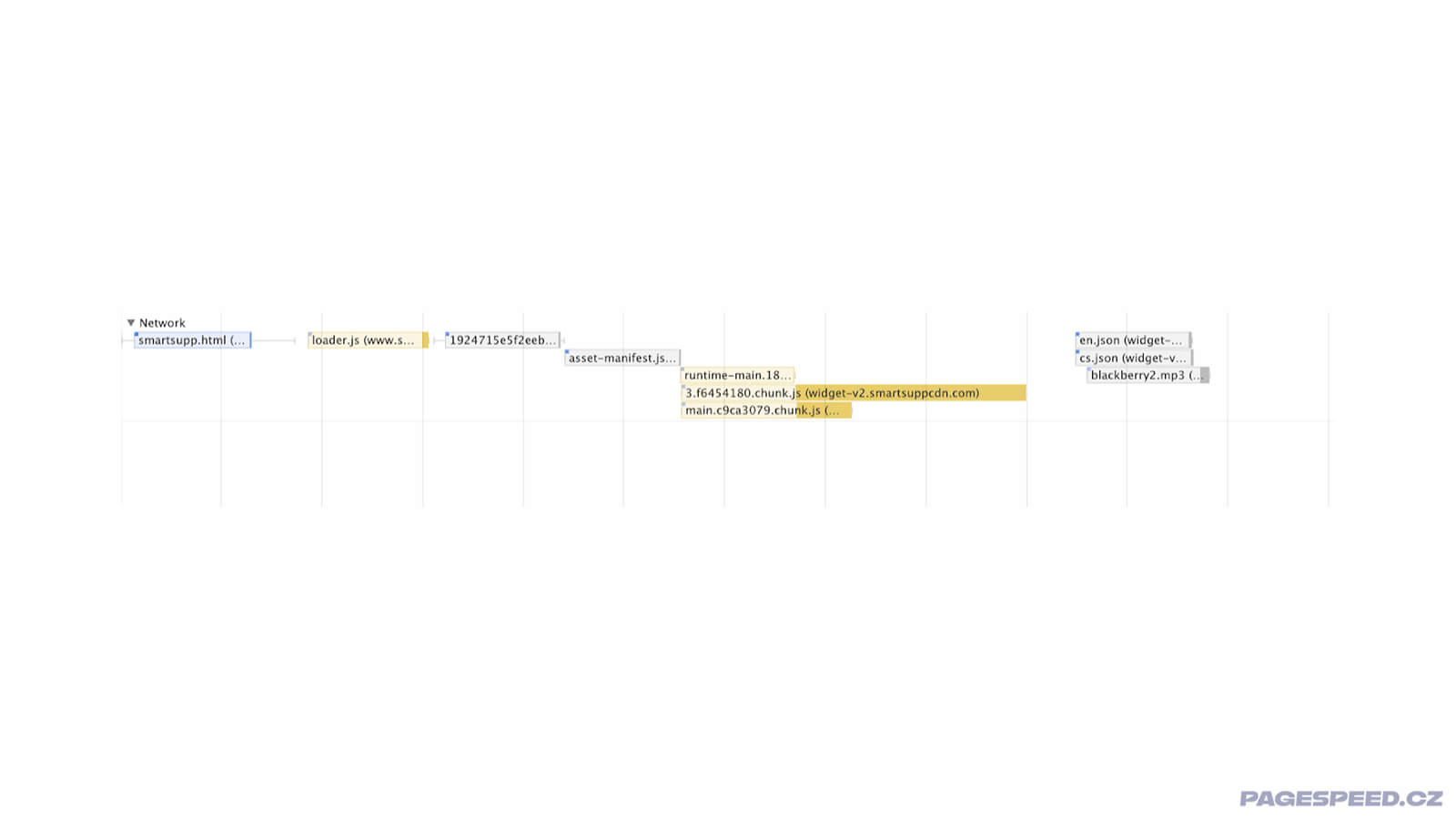 File download waterfall for Smartsupp.
The JavaScript runtime itself runs around 380 ms in the browser, which we regard as a solid result.
Facebook Chat Plugin
The chat appears around 6 seconds. A key improvement is the data size discussed above; there’s a lot of data and JavaScript to fetch and run, which pushes the display out. Large payloads also slow down other resources on which the site depends.
Given the data volume, lazy loading would be most beneficial for Facebook Chat, as discussed later.
Tawk
The chat appears around 3 seconds. The download waterfall looks almost textbook:
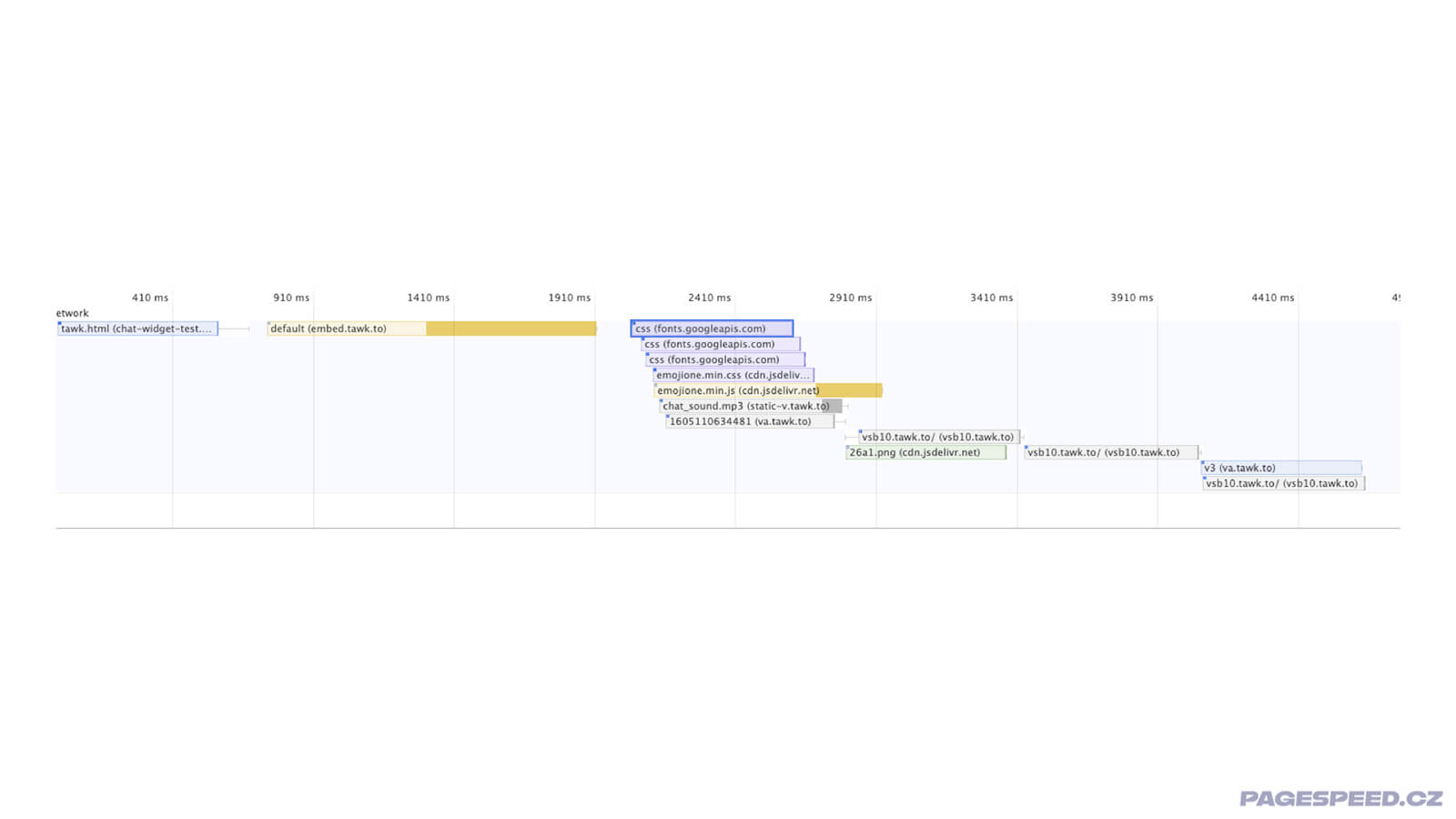 Tawk widget file-download waterfall looks like a real waterfall. Source: Chrome DevTools.
There isn’t much to add here. We were surprised only by three references to a Google font. It also seems the same file is being requested multiple times:
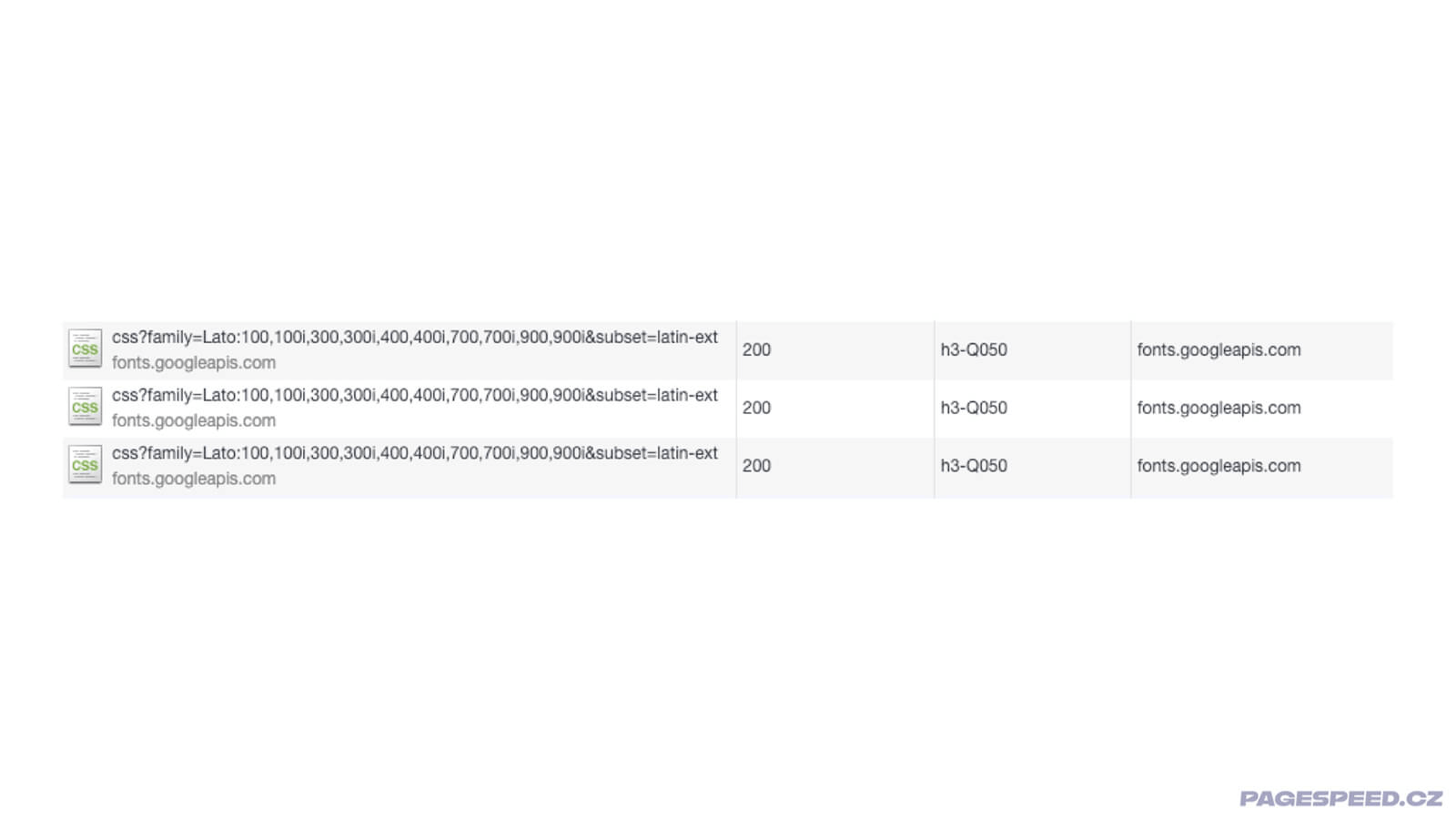 Multiple requests to the same files slightly mar the Tawk impression, but it’s a minor issue mitigated by cache.
The runtime itself processes in about 300 ms, again a very good result.
A few notes on Smartsupp and LiveAgent
We were pleasantly surprised by the strong results from two local players—Smartsupp (Czech) and LiveAgent (Slovak).
Smartsupp recently migrated to a new widget version, and for many clients the numbers improved significantly.
We’ve been in touch with both companies and can confirm speed is taken seriously.
We’d also like to encourage you: if you’re using one of the slower chats for any reason, don’t hesitate to reach out to the authors. This is a general recommendation we’ve saved for the end.
Another Czech software—FoxyDesk—also performed well, but we’d prefer the widget to download fewer files and less data overall.
General recommendations for developers, marketers, and website owners
Here are broad recommendations, regardless of which live chat tool you use.
Choose live chat with speed in mind
When selecting a live chat, speed should be a key criterion. As shown by our study, many widgets can significantly affect your site speed.
Measure third-party component impact
Measure third-party component impact. We use third-party analysis in SpeedCurve, but a Lighthouse-based third-party analysis can also help. See more on third-party analysis here. In Monitoring PLUS, we offer a way to measure the overall impact of third-party components using the 3PBT metric.
If you notice a negative impact on first paint, start by contacting the authors—perhaps they’ve yet to optimize this.
Consider lazy loading the widget
Consider lazy loading the chat widget.
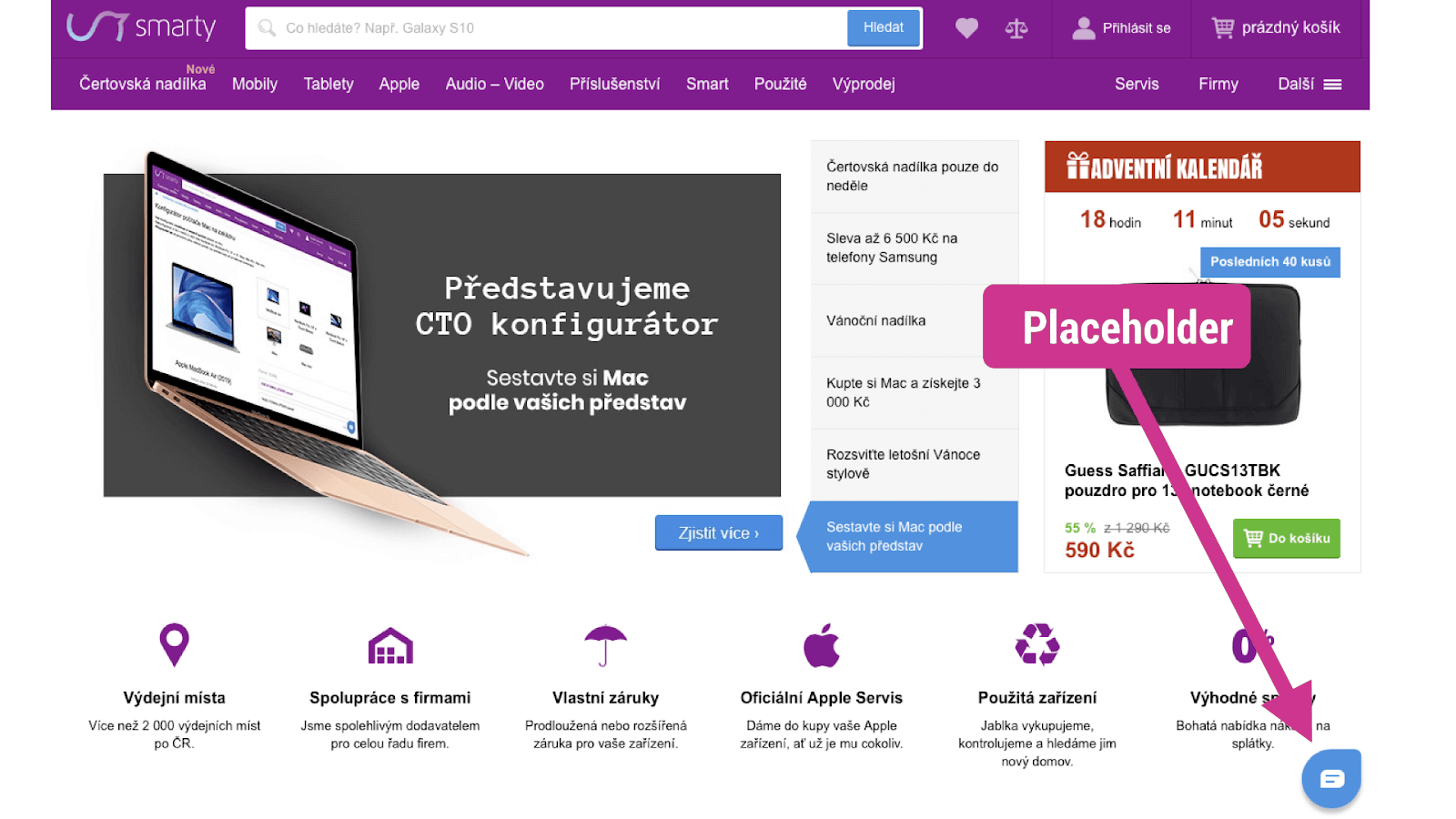 Optimized widget on Smarty.cz. Source: Speed Matters.
Lazy loading replaces the live chat with a placeholder image or icon and loads the actual widget later, triggered by user action (clicking the placeholder or hovering) or after a set time so the widget doesn’t block critical page resources.
If you’d like help optimizing your live chat or site speed, contact PageSpeed.cz.